
What Posture Release Imagery is
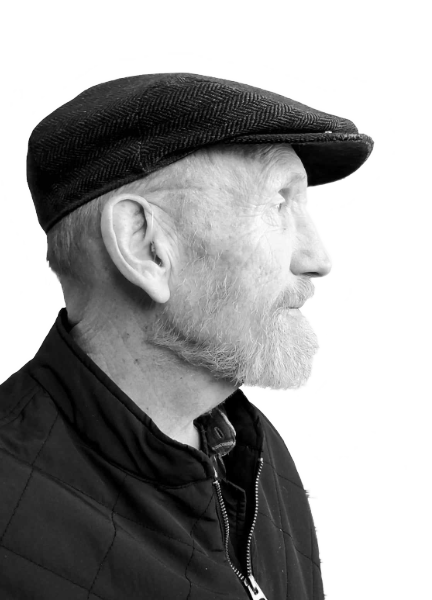 Welcome, I am John Appleton. My discoveries, found in Posture Release Imagery, involve a new understanding of the source of much of people's enduring body pain. They also help us to understand, more specifically, the process we went through in becoming an upright species, that I call a “secondarily upright” species. (Virtually all animals are "upright").
PRI is a rewarding, though challenging, way of discovering a healthier use of our bodies. For those who learn to work with this imagery, the understanding and practice unleashes improved lightness, stability, and gracefulness. Often, the most rewarding part of the learning is the cessation or reduction of pain!
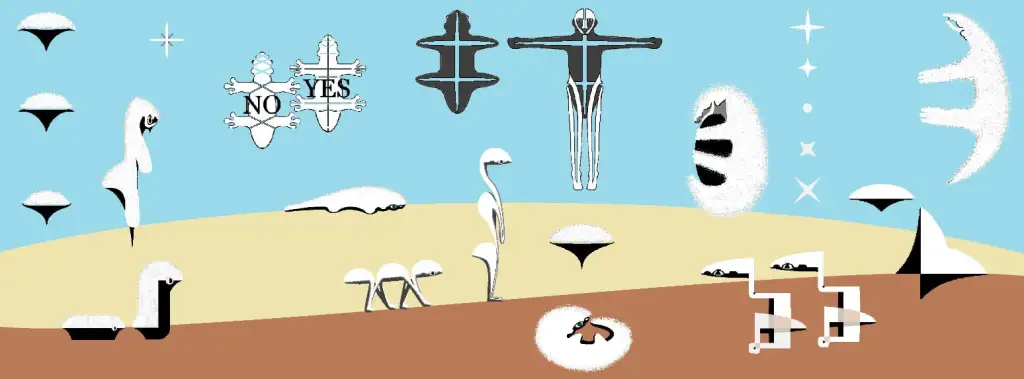
PRI came from three sources of inspiration: the Alexander Technique, evolutionary theory, and a specific theory of personality types. The images call upon the sensory wisdom of our “right brain,” which is that part of our thinking that is visual and holistic, as opposed to verbal and linear.
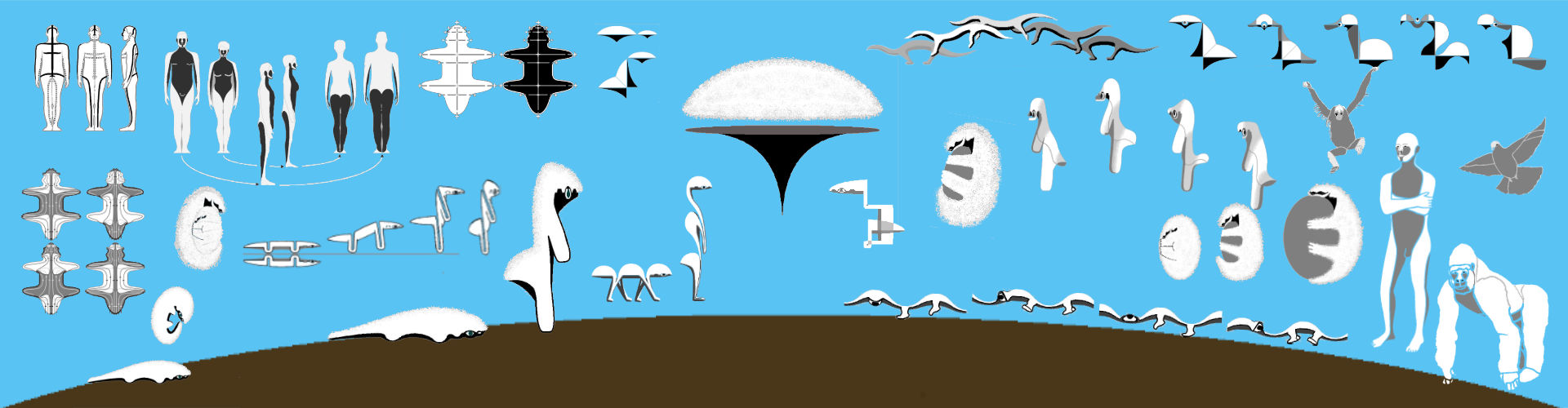
If you study the mural of imagery above, you may begin to see that it visually suggests what I consider several principles of healthy use of our bodies. One is the basic relationship of the dorsal and ventral surfaces on humans and all animals. The images describe the process of humans evolution to a "secondarily upright" status. (All animals are upright, so humans required a more defined term for uprightness).
… and for Whom?
You decide if it is worth exploring. It could be that you are acutely aware of pain in your body already and a new modality is worth exploring for solutions. Or you are interested in the theories/discoveries presented here concerning animal and human evolution. That, in itself, can be eye-opening. If you give it a good chance, both aspects of Posture Release Imagery can become important to you.
Dancers and the Physically Active
It promotes more naturally graceful movement and efficient balance.
People with Pain & Disability
It can considerably reduce chronic pain by changing the underlying sensory patterns.
Those intellectually interested & bodyworkers with professional interest
It can provide a rigorous new evolutionary model to integrate into professional practice.
PRI’s History and Discovery
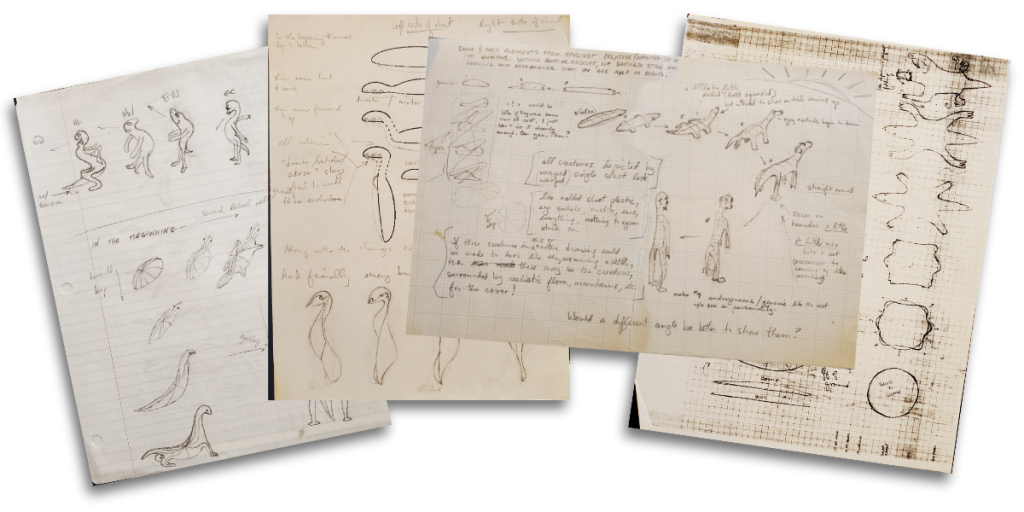
Years ago (1992), I was giving a lesson in the Alexander Technique to a young theater student. I was working with him seated in a chair and having difficulty getting him to “lighten up.” When my verbal suggestions and light (but still novice) hands-on cues failed to produce change, I happened to suggest that he imagine that he is a cheetah looking over a savanna for prey. This mental image had been a suggestion that I, off-handedly, had heard from my A.T. teacher when she was having trouble getting me “up” (Alexander Technique language). I never heard the suggestion again from her nor any other A.T. teacher. However, it obviously worked for my student in a way that my earlier approaches had not. He “shot up” in stature (without leaving the chair).
This event of providing a student with “colorful” direction marked the beginning of years of experimentation with imagery. It resulted in numerous new levels of excitement and understanding for me, along with more pain relief and freedom within myself.
The development of the imagery became useful for new students, most of whom were unfamiliar with the Alexander Technique. And musing on my own drawings of simplified evolution brought about my first new principles. They related to the appropriate relationship between the dorsal and ventral surfaces of the body.
Where the dorsal and ventral surfaces on the body are actually located is currently (June, 2025) not accurately displayed on the internet. I hope that some of my illustrations, which show how we evolved from our animal “forefathers”, are someday available there. It is an evolutionary model of human development that shows how we became “secondarily” upright. (All animals are upright in a very meaningful sense).
I hope that one day, my model is accepted and available to people who google: “illustrations of dorsal and ventral surfaces on humans.” Having many people see PRI’s images and explanations could be of considerable value in assisting people toward a healthier understanding of ourselves and how we evolved to where we are.
About me, John Appleton
I was born in 1945 and grew up in Denver, Colorado, graduating from Colorado State University in 1967. Since the years following this graduation, I have been on a quest for greater understanding of mind/body unity. Along the trail were experiences in and study of Reichian therapy, encounter group therapy, Rolfing, Tai Chi, and the Alexander Technique. I was certified as a teacher of the Alexander Technique in 1986 following a three-year training course with Joan and Alex Murray. In addition, years spent as a carpenter were valuable in providing me with numerous opportunities to experience the physics of use and the exhilaration of better use of the physical.
Finally, what should not be left out of this short bio is the added stimulus I had from severe lower back pain. This happened a year or more before beginning training in the Alexander Technique. From the experience of the Alexander Technique, I went on to discover and develop Posture Release Imagery. Pain can be a wonderful motivator.